Physics A Level | Chapter 3: Dynamics 3.1 Force, mass and acceleration
chevron_forward
visibility 589update 4 years agobookmarkshare
LEARNING INTENTIONS
In this chapter you will learn how to:
- recognise that mass is a property of an object that resists change in motion
- identify the forces acting on a body in different situations
- describe how the motion of a body is affected by the forces acting on it
- recall F = ma and solve problems using it, understanding that acceleration and resultant force are always in the same direction
- state and apply Newton’s first and third laws of motion
- recall that the weight of a body is equal to the product of its mass and the acceleration of free fall
- relate derived units to base units in the SI system and use base units to check the homogeneity of an equation
- recall and use a range of prefixes.
BEFORE YOU START
- Make a list of all the different types of force that you know about. Do you have the same list as someone else? Discuss any differences and describe the types of force to each other.
- What prefixes do you know that may be placed before a unit? For example, the ‘c’ in cm is the prefix ‘centi’ and means times ${10^{ - 2}}$. Write down those that you know and what they mean then see if you are correct.
DYNAMIC AEROPLANES
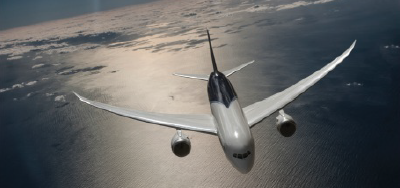
Figure 3.1 shows a modern aeroplane. To decrease cost and the effect on the environment, such an aircraft must reduce air resistance and weight, yet be able to use air resistance and other forces to stop when landing. If you have ever flown in an aeroplane you will know how the back of the seat pushes you forwards when the aeroplane accelerates down the runway. The pilot must control many forces on the aeroplane in take-off, flying and landing.
In Chapters 1 and 2 we saw how motion can be described in terms of displacement, velocity, acceleration and so on. Now we are going to look at how we can explain how an object moves in terms of the forces that change its motion.
Apart from air resistance, see how many other forces you can discover that act on an aeroplane.
Compare your list with someone else. What causes all these forces?
Figure 3.1: A modern aircraft flying over the ocean.
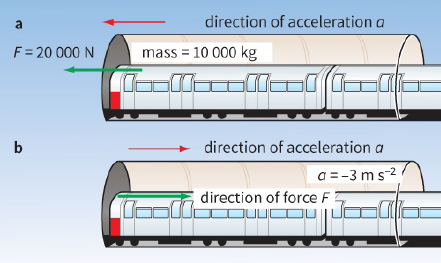
Figure 3.2a shows how we represent the force that the motors on a train provide to cause it to accelerate.
The resultant force is represented by a green arrow. The direction of the arrow shows the direction of the resultant force. The magnitude (size) of the resultant force of $20000 N$ is also shown.
.Figure 3.2: A force is needed to make the train a accelerate, and b decelerate
To calculate the acceleration a of the train produced by the resultant force F, we must also know the train’s mass m (Table 3.1). These quantities are related by:
In Figure 3.2b, the train is decelerating as it comes into a station. Its acceleration is $ - 3.0\,\,m\,{s^{ - 2}}$. What
force must be provided by the braking system of the train?
$F = ma = 10000 \times - 3 = - 30000N$
The minus sign shows that the force must act towards the right in the diagram, in the opposite direction
to the motion of the train.
Newton’s second law of motion
The equation we used, $F = ma$, is a simplified version of Newton’s second law of motion: For a body of constant mass, its acceleration is directly proportional to the resultant force applied to it.
An alternative form of Newton’s second law is given in Chapter 6, when you have studied momentum.
Since Newton’s second law holds for objects that have a constant mass, this equation can be applied to a train whose mass remains constant during its journey.
The equation $a = \frac{F}{m}$ relates acceleration, resultant force and mass. In particular, it shows that the bigger the force, the greater the acceleration it produces. You will probably feel that this is an unsurprising result. For a given object, the acceleration is directly proportional to the resultant force:
$a \propto F$
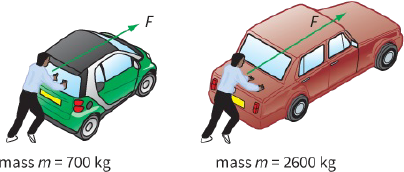
The equation also shows that the acceleration produced by a force depends on the mass of the object. The mass of an object is a measure of its inertia, or its ability to resist any change in its motion. The greater the mass, the smaller the acceleration that results. If you push your hardest against a small car (which has a small mass), you will have a greater effect than if you push against a more massive car (Figure 3.3).
So, for a constant force, the acceleration is inversely proportional to the mass:
$a \propto \frac{1}{m}$
The train driver knows that when the train is full during the rush hour, it has a smaller acceleration. This is because its mass is greater when it is full of people. Similarly, it is more difficult to stop the train once it is moving. The brakes must be applied earlier to avoid the train overshooting the platform at the station.
.Figure 3.3: It is easier to make a small mass accelerate than a large mass
WORKED EXAMPLES
1) A cyclist of mass $60 kg$ rides a bicycle of mass $20 kg$. When starting off, the cyclist provides a force of $200 N$. Calculate the initial acceleration. Step 1: This is a straightforward example. First, we must calculate the combined mass m of the bicycle and its rider:
$m = 20 + 60 = 80 kg$
We are given the force F:
force causing acceleration $F = 200 N$ Step 2: Substituting these values gives:
$\begin{array}{l}
a = \frac{F}{m}\\
= \frac{{200}}{{80}}\\
= 2.5\,m\,{s^{ - 2}}
\end{array}$
So the cyclist’s acceleration is $2.5\,m\,{s^{ - 2}}$.
2) A car of mass $500 kg$ is travelling at $20\,m\,{s^{ - 1}}$. The driver sees a red traffic light ahead, and slows to a halt in $10 s$. Calculate the braking force provided by the car. Step 1: In this example, we must first calculate the acceleration required. The car’s final velocity is $0\,m\,{s^{ - 1}}$, so its change in velocity $\Delta v = 0 - 20 = - 20\,m\,{s^{ - 1}}$
$\begin{array}{l}
accleration\,a = \frac{{change\,in\,velocity}}{{time\,taken}}\\
= \frac{{\Delta v}}{{\Delta t}}\\
= \frac{{ - 20}}{{10}}\\
= - 2\,m\,{s^{ - 2}}
\end{array}$ Step 2: To calculate the force, we use:
$F = ma = 500 \times - 2 = - 1000N$
So the brakes must provide a force of $1000 N$. (The minus sign shows a force decreasing the velocity of the car.)
Questions
1) Calculate the force needed to give a car of mass $800 kg$ an acceleration of $2.0\,m\,{s^{ - 2}}$.
2) A rocket has a mass of $5000 kg$. At a particular instant, the resultant force acting on the rocket is $2000N$. Calculate its acceleration.
3) (In this question, you will need to make use of the equations of motion that you studied in Chapter 2.)
A motorcyclist of mass $60 kg$ rides a bike of mass $40 kg$. As she sets off from the lights, the forward force on the bike is $200 N$. Assuming the resultant force on the bike remains constant, calculate the bike’s velocity after $5.0 s$.